
HEAT STRENGTHENED GLASS
What is Heat Strengthened Glass
Heat strengthened glass is a semi tempered glass, which has been strengthened thermally by inducing a surface compression of 6000 to 9000 psi as compared to a range of 11000 to 20000 psi in case of fully tempered glass. It is two times stronger than annealed glass. Though it is not considered to be a safety glass, it is widely used on building facades due to better optics.
Features & Benefits
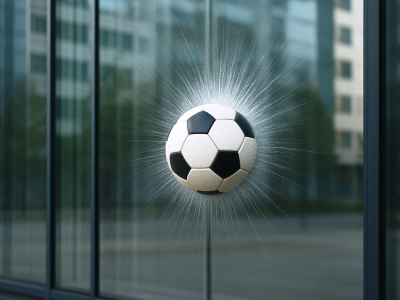
Strong
Heat Strengthened Glass is 2 times stronger than normal annealed glass.
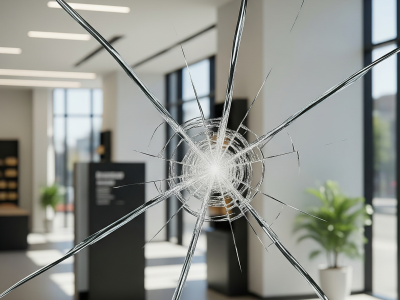
Safe
The fragments tends to remain in sashes and having less probability of fallout.

Better Optics
Heat Strengthened Glass has flatter finish and has lesser optical distortions.
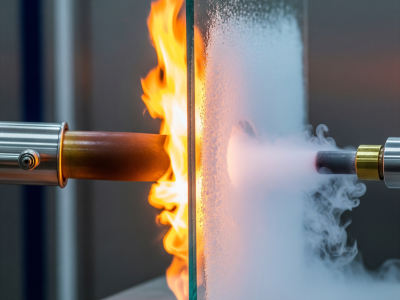
No Thermal Breakage
Heat Strengthened Glass will resist temperature difference of up to approximately 130°c.
Size & Specification Options
- Available in 3, 4, 5, 6, 8, mm thickness
- Maximum Size:- 2400 X 4800
- Minimum Size:- 220 mm diagonal
- Bent Toughened Glass:- Maximum Size 500 (height) X 1100 (width) mm, 800 mm minimum radius and thickness ranges between 5 mm to 12 mm
The GSC Advantage
- First in Architectural glass in India with over 30 years of experience in glass processing.
- Processing in Greater Noida
- Flat as well as bend glass possible.
- Best quality glass exported worldwide including Europe.
- Most advanced tempering line capable of processing of most difficult Low-E glasses.
- Best optics and least distortion.
- Strongest possible glass.
Toughened Glass Vs Heat Strengthened Vs Annealed Glass
| Properties | Tempered Glass | Heat Strengthened Glass | Annealed Glass |
|---|---|---|---|
| Thermal Stress Resistance | Up to 250 °C | Up to 130 °C | Up to 50 °C |
| Strength | 4× stronger than annealed | 2× stronger than annealed | Not strong |
| Bending Strength | 120–200 N/mm² | 60–100 N/mm² | ~40 N/mm² |
| Design Stress | 50 MPa | 27 MPa | 17 MPa |
| Surface Compression | >10,000 psi (69 MPa) | 3,500–7,500 psi (24–52 MPa) | Up to 2,800 psi (19 MPa) |
| Safety Rating | ✅ Approved as safety glazing | ❌ Not approved as safety glazing | ❌ Not approved as safety glazing |
| Site Alterations | ❌ Not possible | ❌ Not possible | ✅ Possible |
| Flatness | Slight bow and corrugation | Less bow/corrugation than tempered | Very flat |
| Optical Quality | Reasonably good | Good (better than tempered) | Very good |
| Lamination Requirement | Min 1.52 mm PVB | Min 1.52 mm PVB | Min 0.38 mm PVB |
| NiS Breakage Risk | Prone | Extremely rare | Non-existent |
| Heat Soaking Requirement | Recommended | Not necessary | Not required |
Various Applications of Heat Strengthened Glass
Heat Strengthened Glass – Frequently Asked Questions (FAQs)
Heat Strengthened Glass is made on state of the art electrically heated horizontal furnace, which heats the glass to an uniform temperature of approximately 660ºC. Ceramic rolls convey the glass through these furnace at speeds regulated to ensure temperature uniformity and minimal optics distortions. The heat strengthened process parallels the traditional process of glass tempering, except that the heating temperature are lower and the cooling cycle is less rapid. During production, non-destructive verification of the range of stresses is done by using grazing angle surface polarimeter to ensure the right surface compression.
Heat Strengthened glass have better optics because of lower temperature at processing which leads to less distortion on the glass.
Heat-strengthened glass is not a safety glass product but it is suitable for security laminates.
NO, heat strengthened glass does not breaks spontaneously.
Laminated glass resists intrusion because the inter-layer continues to safeguard the building even after the glass itself is broken. Security glass cannot be cut from only one side, so ordinary glass cutters are useless as break-in tools. Laminated glass tends to resist impact. In multiple configurations, it can even resists bullets, heavy objects, or small explosions. In most cases, it takes many blows, all in the same spot, to penetrate the glass.
No, Heat Strengthened glass is not suitable for glass doors.